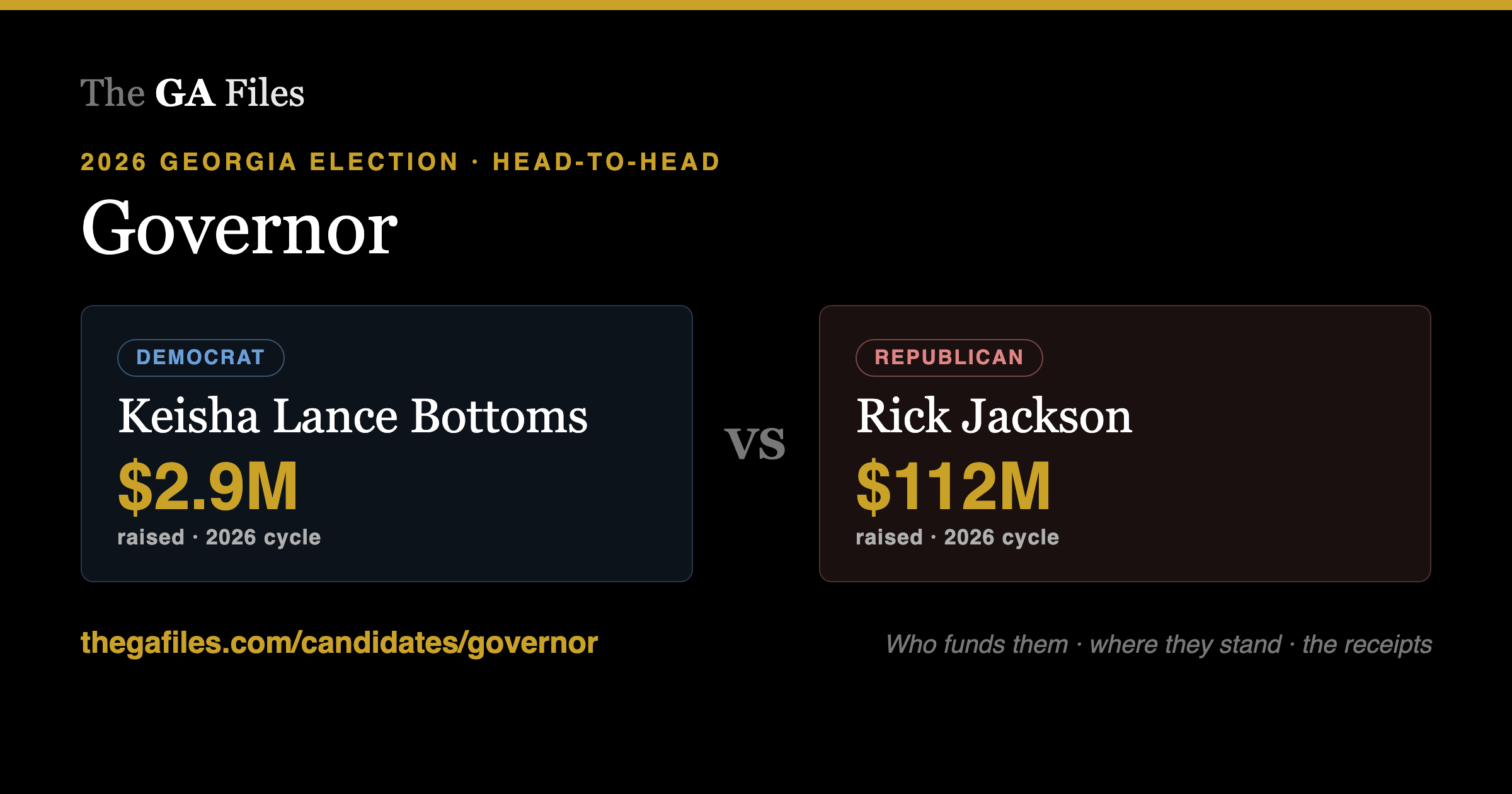
Founder and CEO of Jackson Healthcare in Alpharetta, one of Georgia's largest health-care staffing firms. He grew up in Atlanta's Techwood Homes public housing and spent time in foster care as a teen — a “foster care to billionaire” arc central to his campaign. A first-time candidate and Trump ally, he poured more than $100 million of his own money into the race and beat Lt. Gov. Burt Jones in the June 16 GOP runoff.
Top contributors
Self-funded to a degree with no modern Georgia parallel. Through the July 31 CCDR his committee reports $118.9 million raised — and $111.9 million of it, about 94%, came from Jackson himself, in single contributions as large as $50 million. (The GA Files corrected this figure: Georgia's public top-donor tool splits his giving across two spellings of his own name and attributes roughly $10 million of it to an unrelated small donor. Summing the underlying transactions, which reconcile to within 0.1% of his committee's reported total, gives $111.9 million.) What is new in the general election is outside money. After avoiding fundraisers during the primary, he took in roughly $13 million between June 11 and July 31, most of it a $10 million donation from the Republican Governors Association — and that money did not go to his campaign account. It went to For All Georgians, Inc., a leadership committee, a vehicle created by Georgia's 2021 law SB 221 that lets nominees for governor accept contributions of unlimited size, including during the legislative session when other fundraising is barred. For All Georgians has since routed $5.27 million into the campaign, making it far and away his largest source other than himself. Beyond those two, his donor list falls off a cliff: no other contributor has given more than $34,800. Other named outside donors include railroad executive Ben Tarbutton, Evans General Contractors of Alpharetta and Curae Finance of Atlanta at $100,000 each. He has booked about $102 million in general-election ad reservations, up from the $87 million buy announced July 27.
- $101,906,190.59JACKSON, RICHARD L. (Alpharetta, GA)
- $10,093,200.00ELY, SEAN (EMERSON, GA)
- $5,271,177.39For All Georgians, Inc. (Atlanta, GA)
- $26,400.00KURTZ, LESLIE K. (ALPHARETTA, GA)
- $26,400.00BRADBURY, THOMAS (Woodstock, GA)
- $26,400.00MCLANE, JAMES S. (VESTAVIA, AL)
- $26,400.00INSPIRATA CAPITAL, LLC (ATLANTA, GA)
$118,914,891 raised · $4,319,290 cash on hand — as of Aug 7, 2026 (GA Ethics latest filing).
Source: AJC — Rick Jackson raises $13M in outside money (Greg Bluestein, Aug. 8, 2026) · Capitol Beat — Jackson leads Bottoms in fundraising (Ty Tagami, Aug. 11, 2026) · AJC — How Georgia's unlimited money machine is powering the governor's race · Georgia Ethics Commission (PeachFile) — 2026 Jul 31 CCDR · NBC News · AJC — how Jackson spent $108M in the primary · Atlanta News First — $87M general-election ad buyPPP loan
Forgiven $2,560,996 — Premier Anesthesia — five Jackson Healthcare entities (Alpharetta, GA), April–May 2020.
| Borrower | Loan | Approved | Forgiven | Jobs |
|---|
| Premier Anesthesia of Montgomery, PC | $1,204,687 | Apr. 29, 2020 | $1,218,086 | 47 |
| Premier Anesthesia of Texas PA | $573,469 | Apr. 16, 2020 | $580,036 | 22 |
| Premier Anesthesia of Delaware LLC | $373,930 | May 1, 2020 | $378,069 | 15 |
| Premier Anesthesia of Pennsylvania PC | $301,770 | Apr. 12, 2020 | $305,259 | 12 |
| Premier Anesthesia of New York PC | $107,140 | Apr. 15, 2020 | $81,087 (part) | 4 |
| 5 entities | $2,560,996 | |
Five Premier Anesthesia companies — state-level entities in the Jackson Healthcare family of companies, which Jackson founded in 2000 and chairs as CEO — each filed from Jackson Healthcare's Alpharetta headquarters, through the same lender, within three weeks of one another in spring 2020, and together drew $2,560,996 in first-draw PPP loans covering 100 reported jobs. Jackson Healthcare first passed $1 billion in annual revenue in 2018 and $2 billion in 2022. SBA's rule for the program said a borrower is normally counted together with its affiliates against the 500-employee limit, waiving that test only for hospitality businesses, franchises and SBIC-backed firms — none of which these healthcare entities are. Whether the five should have been aggregated is a legal determination; these records do not make it, and nothing in them shows the question being reviewed by SBA or the lender. Every figure here is read directly from the SBA's own loan file.
Sources
Accountability File
His company paid $3 million to settle claims it exploited immigrant nurses — while he campaigned on deportation
Settled — no admission of wrongdoingSettled, with no admission of wrongdoing. Avant denied the allegations throughout the litigation and says its nurses came to the United States lawfully, often after waiting years for visa approval — and that is accurate: these were legal, visa-sponsored workers, not undocumented hires, and this should not be confused with the separate April 2026 dispute over undocumented laborers. A settlement is not a finding of liability. “Stay-or-pay” contracts are also common across the nurse-recruiting industry, and Jackson has been criticized from the right for the same business — for recruiting foreign nurses rather than Americans. What is documented is the settlement itself, its timing, and that a federal magistrate let the forced-labor and racketeering claims proceed rather than dismissing them.CNN reported on August 20, 2026 that Avant Healthcare Professionals — a Jackson Healthcare company that recruits foreign nurses to staff U.S. hospitals — agreed to pay more than $3 million to settle a class action brought by immigrant nurses. The nurses alleged Avant lured them with promises of the American Dream, paid substandard wages, and locked them into multi-year contracts carrying five-figure penalties if they left early; the company sought $41,832 from one nurse who quit, payable within 30 days. They further alleged that Avant threatened to contact Immigration and Customs Enforcement when they tried to leave. Lawyers from the worker-rights nonprofit Towards Justice brought the claims under the Trafficking Victims Protection Act and the Fair Labor Standards Act, and a federal magistrate found the forced-labor and racketeering allegations credible enough to proceed before the case became a Florida class action. The settlement was reached June 22, 2026 — six days after Jackson won the Republican runoff for governor — and covers more than 5,000 current and former workers, roughly $2 million to the nurses and about $1 million in attorneys' fees, with unpaid fees waived. The reporting draws a contrast with Jackson's campaign, which ran a “deported or departed” ad and pledges to make Georgia first in the nation for deportations: the company that built his fortune depends on the immigration system he runs against.
Source: CNN — GOP candidate's company paid $3M to settle claims it exploited immigrant nurses (Aug. 20, 2026) · Towards Justice — Avant litigation · Bloomberg Law — ‘Stay-or-Pay' suits cast light on immigrant nurse recruiting · WSB-TV — Jackson stands by ‘deported or departed' adSigned a state contract extension 21 days before saying he would “never” do business with Georgia
Documented — no wrongdoing allegedNot alleged illegal, and not a finding of wrongdoing. This is a renewal of an existing contract, not a bid for a new one, and Jackson is not governor — his pledge is prospective, about what he would do in office. His campaign has said Jackson Healthcare will not bid on new state contracts and will “work to responsibly unwind” existing ones, and an orderly unwind of a contract supplying clinicians to state psychiatric facilities plausibly takes time. The overlap with a Jackson administration would be about six months, and only if he wins. 11Alive reported it sought comment from his campaign; we have seen no response and will publish one. What is not in dispute is the sequence and the signature.LocumTenens, a subsidiary of Jackson Healthcare, supplies temporary clinicians to the Georgia Department of Behavioral Health and Developmental Disabilities. State records show the agency has paid the company $17,903,044 since 2022. On July 22, 2026 — as the Republican nominee for governor — the company renewed that contract through June 30, 2027, and 11Alive reported that one of the renewal documents carries Rick Jackson's own signature. The next governor is sworn in in January 2027, so the contract runs roughly six months into the term Jackson is seeking. Twenty-one days after signing, asked at a campaign appearance about his business with the state, Jackson said: “I don't want even the appearance that there's ethics impropriety and all that,” and “I never will do business with the state of Georgia” as governor. His opponent, Keisha Lance Bottoms, told reporters in Cobb County: “He says he's going to dial back his business with the state, but my understanding is that just last week, he got another contract from the state. So don't just say it. Do it.” The renewal is separate from — and additional to — the roughly $1 billion in state payments to Jackson Healthcare and affiliates already documented since fiscal 2020.
Source: 11Alive (Doug Richards) — Despite pledge to “unwind” his business, Rick Jackson extends a state contract · AJC — Rick Jackson promises to ‘unwind’ his company's state contracts if elected · Healthbeat — Jackson's health care company and its state contractsA $35 million loan, at 14% interest, to the bankrupt Alabama hospital that owed his company $10 million
Documented — no wrongdoing allegedNot alleged illegal, and not a finding of wrongdoing. Debtor-in-possession lending routinely carries high interest, senior repayment priority and lender control, because the borrower is insolvent and ordinary credit is unavailable; without the loan the hospital might have closed in early 2025, and Jackson declined to buy it outright. Jackson Hospital is not named for, owned by, or affiliated with Rick Jackson — his own company has said the two are “separately owned and operated” despite sharing the Jackson name. Critically, neither the AJC nor the public record states how much, if anything, Jackson's companies have actually collected in interest or fees; the hospital remains in financial distress and the loan does not appear to have been repaid. Claims that he “profits off hospital closures” go beyond what the reporting establishes. His campaign says “improving healthcare is personal for Rick.”Jackson Hospital in Montgomery, Alabama — a facility unrelated to Rick Jackson despite the shared name — filed for Chapter 11 bankruptcy in February 2025. Jackson's medical staffing company was already its second-largest creditor, with what the Atlanta Journal-Constitution described as “nearly $10 million in unpaid bills.” His Jackson Investment Group then became the hospital's bankruptcy lender: a debtor-in-possession loan that began at roughly $22 million and was later extended by the court to $35 million. The AJC reported the loan “comes with a 14% interest rate — that increases to 19% if payment is missed,” plus millions in additional fees, and “gives Jackson's company close control over the hospital and puts him first in line to be repaid.” Bankruptcy filings also provide that once $100 million in public grants is secured, the hospital's board is reconstituted with members acceptable to the lender — tying board control to the arrival of taxpayer money — and pledge the hospital's litigation against Blue Cross Blue Shield of Alabama as collateral. Jackson weighed buying the hospital outright but told Gov. Kay Ivey the $250 million to $300 million turnaround cost was too steep: “There's no way anybody could justify — certainly not us — to do that.” A reorganization plan was confirmed April 28, 2026, but the hospital narrowly avoided closing on July 1 and has secured about $61 million of the $293 million it says it needs, including roughly $80 million pledged by the city, county and state. The relevance to Georgia is the policy underneath it: Alabama, like Georgia, is one of ten states that has not adopted full Medicaid expansion, and researchers consistently find expansion states experience fewer hospital closures. Jackson opposes full expansion, favoring block grants and work requirements — the approach Georgia already tried through Pathways, which had enrolled about 12,752 people as of late 2025.
Source: AJC — Why Georgia governor candidate Rick Jackson spent millions on a failing hospital (Riley Bunch, Aug. 10, 2026) · 1819 News — Jackson Hospital gets loan to stay open after declaring bankruptcy · Yellowhammer News — what the bankruptcy records show · Healthcare Finance News — hospital avoids July 1 closure as Blue Cross talks continue · Jackson Healthcare — statement on the loan~$1 billion in state contracts (conflict-of-interest questions)
Documented — no wrongdoing allegedNot alleged illegal; ethics experts flagged conflicts. Jackson pledged to “unwind” the contracts if elected; the state Senate passed HB 1374 to close the renewal loophole. Update, August 2026: rather than unwinding, a Jackson Healthcare subsidiary renewed a state contract on July 22, 2026 through June 30, 2027 — see the entry above.Jackson Healthcare and affiliates have been paid nearly $1 billion by state agencies since fiscal 2020 — about $710 million from the Department of Community Health for staffing. Critics dubbed a contracting exception the “Rick Jackson loophole”; the Georgia Senate passed HB 1374 (46–0) to require competitive bidding on large contract renewals.
Source: Healthbeat · GPB · AJC — pledge to ‘unwind’Leaked audio: rape-exception abortion remarks
Documented — no wrongdoing allegedComments controversy, not a criminal allegation. Jackson's campaign disputes the framing as “Democratic spin” and says he supports Georgia's current law unchanged; reproductive-rights groups and Democrats condemned the remarks.An audio recording — taped at an April 2026 campaign barbecue in east Georgia and published in June by the Atlanta Journal-Constitution and HuffPost the day after Jackson won the GOP gubernatorial runoff — captured him agreeing with a voter who said a woman alleging rape “needs to prove it” to qualify for Georgia's rape exception to the six-week abortion ban; Jackson added that a pregnancy from rape is “still a life.” The remarks drew scrutiny because a month earlier he had backed rape and incest exceptions on a Georgia Life Alliance questionnaire. Under current law, the rape/incest exception applies only up to 20 weeks and only with an official police report.
Source: CBS Atlanta · HuffPostHis real-estate company sued to keep a family's home after the foreclosure sale was called off — and lost at the Georgia Supreme Court
Documented — no wrongdoing allegedDocumented by a published Georgia Supreme Court opinion, which JIG lost. Nothing here was criminal, and buying at a foreclosure auction is lawful; what the record shows is that the company refused a refund and litigated for four years over a sale the lender had already cancelled. The claims about the Garlands' health and deaths come from their lawyers' filings as reported by The Daily Beast — they are the family's assertions, no court ruled on whether the litigation caused their illnesses, and we have not reviewed those filings ourselves. We also found no other Georgia appellate or federal case with JIG as a party, so this is one documented case, not a demonstrated pattern; county trial-court records are not searchable online. Jackson's campaign did not respond to The Daily Beast.On March 6, 2007, JIG Real Estate, LLC was the high bidder at a foreclosure auction on James and Tammi Garland's home in Canton, paying $239,500. Georgia's corporate registry lists Richard L. Jackson — the candidate — as a member and the registered agent of JIG, at Jackson Healthcare's Alpharetta address. The sale should never have happened: the Garlands had already reached an agreement with Countrywide to cure the default, but the law firm running the auction was not notified in time, something a judge later called an “email snafu.” Two days later, before the deed was delivered, Countrywide rescinded the sale and returned JIG's money with interest. JIG refused the refund, demanded the deed, and sued Countrywide and the Garlands, arguing that Georgia's rescission statute was unconstitutional. It lost at trial and again on appeal: on July 5, 2011, the Georgia Supreme Court affirmed, upholding OCGA § 9-13-172.1 and Countrywide's authority to undo the sale. The ruling is now settled Georgia law and has been cited 27 times. The Daily Beast reported on September 23, 2026 that both Garlands died during the litigation — Tammi in 2008 of an accidental overdose of prescription medication, and James in 2012, after a 2011 suicide attempt left him in a coma for a month — and that their lawyers' filings attributed their health crises, including seizures and a heart attack, to the stress of the fight over the house. Jackson is campaigning for governor on his business record and on housing affordability.
Source: The Daily Beast — MAGA Billionaire's Bitter Housing Battle Ends in Tragedy (Sept. 23, 2026) · JIG Real Estate, LLC v. Countrywide Home Loans, Inc., 289 Ga. 488 (July 5, 2011) — full opinion · CourtListener — case record and citing opinions · Georgia Secretary of State — business search (JIG Real Estate, LLC, control no. 0548489)